



Classification and application of laser cutting
Published on:
2020-12-16
Laser cutting can be divided into four categories: chemical cutting, laser fusion cutting, laser oxygen cutting, laser scribing and controlled fracture. Chemical cutting is the use of a high energy density laser beam to heat the workpiece so that the temperature rises rapidly, reaching the boiling point of the material in a very short time, and the material begins to vaporize and form steam.
The speed of the steam jet is very fast, and at the same time the steam is sprayed out, creating a cut in the material. The heat of vaporization of the material is often very high, so chemical cutting requires a lot of power and power density. Chemical cutting is mainly used for cutting extremely thin metal materials and non-metal materials.
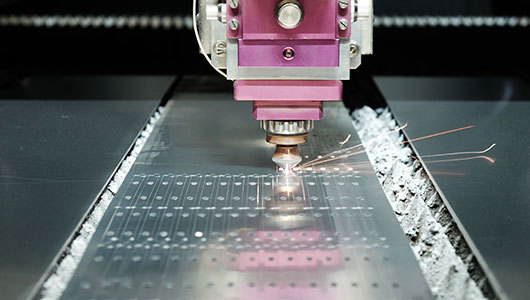
In laser cutting, the metal material is melted by laser heating, and then a non-oxidizing gas is sprayed through a nozzle coaxial with the beam, and the liquid metal is expelled under the strong pressure of the gas to form a cut. Laser melting cutting does not need to completely evaporate the metal, and the energy required is only 1/10 of the evaporation cutting. It is mainly used for cutting certain non-oxidizing materials or reactive metals, such as stainless steel, titanium, aluminum and their alloys.
The principle of laser cutting is similar to oxyacetylene cutting. It uses a laser as a preheating heat source and oxygen and other reactive gases as cutting gases. On the one hand, the blown gas reacts with the cutting metal, causing an oxidation reaction and releasing a large amount of oxidation heat. On the other hand, molten oxide and melt are blown out of the reaction zone to form cuts in the metal.
Since the oxidation reaction in the laser cutting process generates a lot of heat, the energy required for laser oxygen cutting is only 1/2 of that of fusion cutting, and the cutting speed is much faster than chemical cutting and fusion cutting. Laser oxygen cutting is mainly used for easily oxidized metal materials such as carbon steel, titanium steel and heat-treated steel.
Laser cutting scribing uses a high energy density laser to scan the surface of a brittle material, thereby heating the material to evaporate small grooves, and then applying a certain amount of pressure, the brittle material will rupture along the small grooves. The lasers used for laser cutting are usually Q-switched lasers and CO2 lasers.
Relevant News
Sheet metal processing production process
2022-07-06


Jiangsu Songshi metal products Co., Ltd
E-mail:jsss_metal@163.com
Address: No. 32, Haiyan Road, Qidong high tech Industrial Development Zone, Jiangsu Province
Copyright © 2022 Jiangsu Songshi metal products Co., Ltd.