

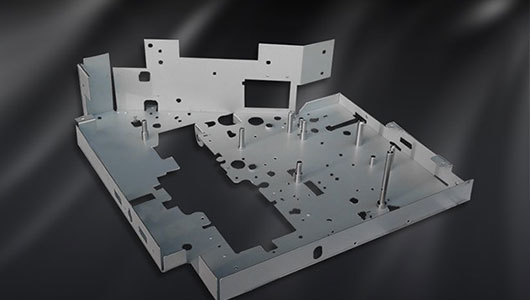

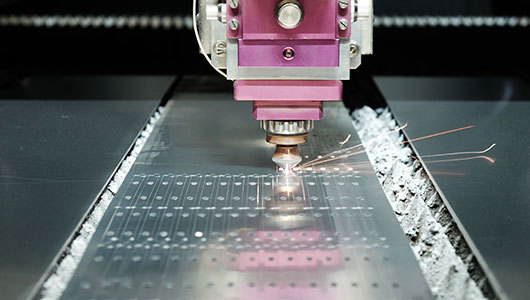

Process flow of sheet metal processing
Published on:
2021-10-27
With the development of today's society, the sheet metal industry is also developing rapidly. At present, sheet metal covers all industries, and there is a certain processing process for any sheet metal, the so-called process. To understand the sheet metal processing process, you must first know Selection of sheet metal materials.
1. Selection of sheet metal processing materials
Commonly used materials in sheet metal are cold rolled sheet (SPCC), hot rolled sheet (SHCC), galvanized sheet (SECC, SGCC), copper (CU) brass, copper, beryllium copper, aluminum (6061, 6061)
1. The cold-rolled sheet SPCC is mainly electroplating and painting, low cost, easy to form, and the material thickness is 3.2 mm.
2. The hot-rolled version of SHCC and the material T3.0mm are also electroplated and painted. The cost is low, but it is difficult to form. The sheet metal processing mainly uses tablet computers.
Galvanized steel sheet SECC, SGCC. SECC electrolytic plate is mainly made of N material, P material and N material, without surface treatment, which is expensive, and P material is used for spraying.
4. Copper surface treatment mainly uses nickel-plated, chrome-plated or untreated, high-cost conductive materials.
Aluminum plate; in general, surface chromate (J11-A), oxidation (conductive oxidation, chemical oxidation), high cost, silver plating, nickel plating.
Aluminum profiles; projects with complex cross-sectional structures are often used in various plugs. The surface is treated like an aluminum plate.
Stainless steel; mainly without any surface treatment, the cost is very high.
Second, review the drawing, create the part process, first understand the various technical requirements of the part drawing. Reviewing drawings is an important part of the part creation process.
1. Confirm that the graphics are complete.
2. The relationship between drawings and views, whether the labeling is clear and complete, and the labeling unit.
3. Assembly relationship, assembly requires key dimensions.
4. The difference between the old and new boards.
5. Translation of foreign language maps
6. Form code conversion.
7. Drawing problem feedback and store.
8. Materials
9. Sheet metal processing quality requirements and process requirements
10. The official release drawings should be stamped with the quality control seal.
Third, the unfolding mode of sheet metal processing is the plan view (2D) unfolded according to the part engineering drawing (3D)
1. The unfolding methods should cooperate with each other, and the material saving and processability should be convenient
2. Reasonable selection of spacing and edge wrapping methods. The spacing below T=2.0 is 0.2, the spacing between T=2-3 is 0.5, and the edge wrapping method adopts the long edge wrapping the short edge (door panel type)
3. Reasonable consideration of tolerance dimensions: the negative difference goes to the end, and the positive difference is half. Hole size: positive difference goes to the end, negative difference goes to half.
4. Phrase direction
5. Tooth extraction, rivet, tear, convex (pack), back position and direction, section view
6. Check material, plate thickness, plate thickness tolerance
7. The inner radius of the bending angle (generally R=0.5) is a special angle relative to the expansion of the time connection. 8. If there is an error-prone place (similar to asymmetry), it must be highlighted
9. Add magnification for large size
10. Where spray protection is required.
Relevant News
Sheet metal processing production process
2022-07-06


Jiangsu Songshi metal products Co., Ltd
E-mail:jsss_metal@163.com
Address: No. 32, Haiyan Road, Qidong high tech Industrial Development Zone, Jiangsu Province
Copyright © 2022 Jiangsu Songshi metal products Co., Ltd.